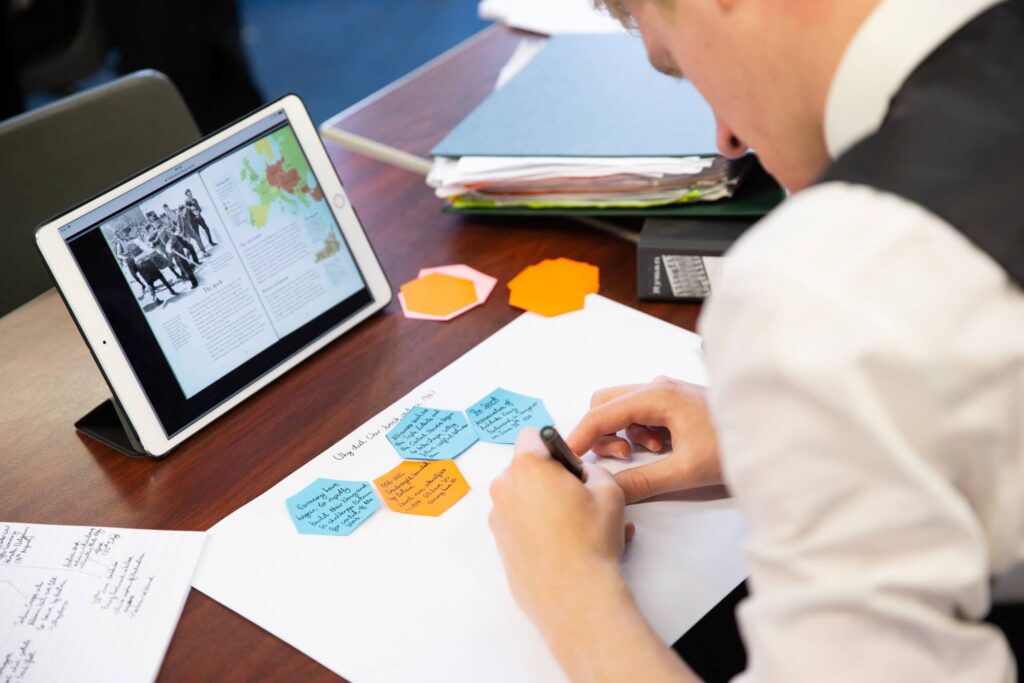
Metacognition is often described as “thinking about thinking.” It’s the ability to understand how you learn, monitor your progress, and adjust your strategies to improve outcomes. In other words, it’s not just about what students know, it’s about how they approach learning itself.
Metacognition is powerful because it transforms students from passive recipients of information into active, self-directed learners. When students reflect on their thinking, respond meaningfully to feedback, and plan their next steps, they develop resilience, confidence, and the ability to tackle challenges independently. Research as outlined in Brown et. Al. (2014) shows that students who practise metacognition learn more effectively, retain knowledge longer, and are better equipped to transfer skills across subjects and real-life situations.
Developing metacognitive habits requires intentional routines, modelling, and opportunities to act on reflection. Below are three key practices you can embed in the classroom.
1. Develop reflective learners who act on feedback
Supporting students to become reflective, self-aware learners starts with teaching them to pause and think meaningfully about their learning. Encourage them to consider what they’ve understood, where they’re struggling, and what they need to do next. Build consistent routines for self-evaluation and go further by showing them how to act on feedback through editing, redrafting, or creating simple action plans.
Practical ways to build these habits include:
- Short reflection routines
- Begin or end lessons with prompts such as “What was the most important thing I learned today?” or “What confused me and why?”
- Use exit tickets asking students to identify one success and one challenge.
- Provide reflection stems like “I improved when…” or “I still need to work on…” to guide their thinking.
- Structured self-evaluation tools
- Introduce simple checklists or success criteria so students can assess where they are before submitting work.
- Use learning journals where students regularly note progress, difficulties, and strategies they tried.
- Build in peer review moments where students exchange work and give each other feedback based on clear criteria.
- Teaching students to act on feedback
- Model how to respond to teacher comments by highlighting one area to work on and demonstrating revision.
- Use colour-coding activities: students highlight where they’ve improved a draft based on specific feedback.
- Provide action-plan templates with prompts like “My next step is…”, “To do this I will…”, or “I will check my progress by…”.
- Build redrafting time directly into lessons so students see improvement as part of the learning cycle which merits classroom time.
2. Support goal-setting and strategic planning
Goal-setting empowers students to take a proactive role in their learning. Helping students set meaningful, manageable goals and monitor progress, turns abstract ideas into concrete actions.
Ways to implement goal-setting in your classroom:
- Guided goal creation
- Ask students to set short-term and long-term learning goals. Example: “By the end of this unit, I will be able to solve quadratic equations without help.”
- Encourage SMART goals (Specific, Measurable, Achievable, Relevant, Time-bound) and model what this looks like.
- Progress monitoring tools
- Visual progress charts to track milestones and celebrate incremental achievements.
- Weekly check-ins to reflect on goals: “What went well this week?” and “What could I do differently next week?”
- Strategy evaluation and adjustment
- Prompt students to reflect on strategies: “Which study methods worked best?”
- Provide opportunities to revise approaches when something isn’t working, such as switching from flashcards to concept maps.
- Model how to break big goals into smaller steps, showing that progress is incremental and iterative.
- Embedding goal-setting in lessons
- Dedicate a few minutes each lesson for students to revisit goals and action plans.
- Encourage students to self-assess against their goals before submitting work.
3. Model metacognition, including your own mistakes
Students learn metacognitive habits best when they see them in action. When you make your thinking visible, you’re not just teaching content, you’re teaching the process of learning itself.
Ways to model metacognition in the classroom:
- Think aloud
- Demonstrate your approach to a complex task step by step. For example, when solving a tricky problem, explain your reasoning: “I’m going to start by breaking this into smaller parts…”
- Share how you choose strategies or make decisions when information is incomplete.
- Embrace mistakes openly
- Share examples of your own past errors and how you learned from them.
- Show how revisiting a failed approach can lead to deeper understanding.
- Reinforce that mistakes are part of the learning cycle, not a sign of failure.
- Problem-solving strategies
- Highlight multiple ways to approach a problem, explaining the pros and cons of each.
- Model planning, checking, and revising work, even in front of the whole class.
- Demonstrate persistence: “I tried one method, it didn’t work, so now I’m going to try this alternative approach.”
- Encourage student reflection on thinking
- Ask questions like “Why did you choose that strategy?” or “How did you decide on that approach?”
- Encourage students to compare different strategies and reflect on which worked best.
If you want to know more about metacognition including the science behind it, read our other blog here
Brown, P. C., Roediger III, H. & McDaniel, M. A. (2014). Make It Stick: The Science of Successful Learning. Cambridge, MA: Harvard University Press.